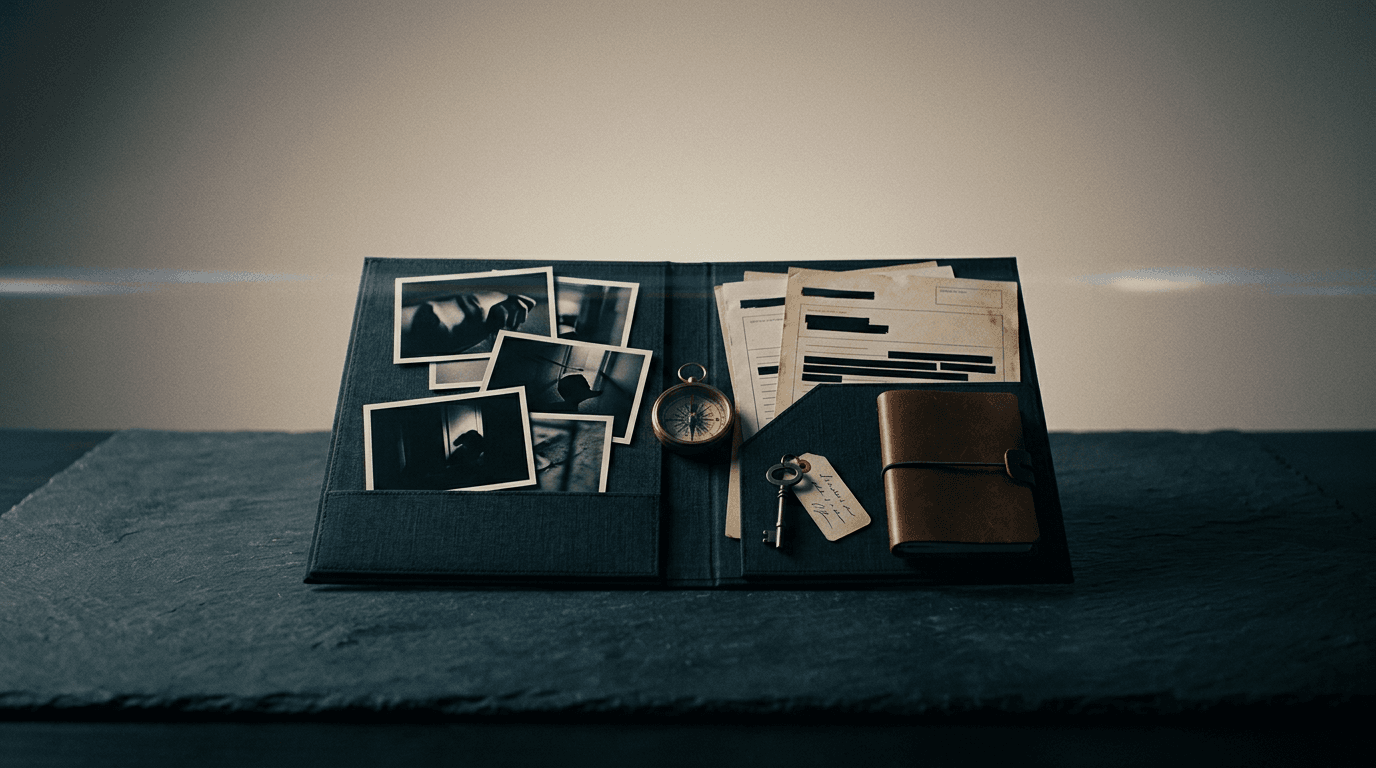
Evidence File Game Design for Immersive Solo and Group Play
Step into the role of lead detective. An evidence file game hands you crime scene photos, autopsies, emails, and texts that feel real enough to touch, turning your table into a task force desk.
This guide explains how evidence file games work, how to evaluate printables vs physical kits, and how to build a compelling at-home investigation for solo players, couples, groups, and team building. If you want instant immersion, realistic documents, and a smooth path from clue to solution, you are in the right place. Key takeaway: prioritize authenticity, clarity, and pacing so your case grips players without confusing them.
What Is an Evidence File Game and Why It Works
An evidence file game is a self-contained mystery that ships or downloads as a dossier of believable artifacts. You examine, cross reference, and debate until the motive, method, and culprit click.
Core components that create immersion
- Crime scene photos: contextual visuals that narrow timelines and contradict alibis.
- Autopsy and lab reports: forensic anchors that constrain theories with hard data.
- Suspect profiles: bios, relationships, and prior incidents that frame motive.
- Witness statements: fallible narratives to test for bias and inconsistencies.
- Digital records: emails, texts, call logs that expose secrets and timelines.
- Press clippings: public perception vs private truth to create red herrings.
Why the format engages all player types
- Solo players get a focused, contemplative puzzle loop.
- Couples get a cooperative debate with clear artifacts to divvy up.
- Groups get dynamic discussion where roles form naturally.
- Teams in workplaces practice communication, evidence handling, and consensus.
Choosing the Right Evidence File Game for Your Group
Selecting the best fit ensures momentum and satisfaction from first clue to final reveal.
Match difficulty to player experience
- First timers: choose cases with explicit objectives and hint systems.
- Mixed groups: medium difficulty with optional side threads for eager solvers.
- Veterans: nonlinear cases with layered timelines and sparse guidance.
Consider time, player count, and setting
- Time: 60 to 150 minutes is ideal for most groups. Longer epics suit dedicated sessions.
- Player count: 2 to 8 keeps discussion balanced. Above 8, split into sub teams.
- Setting: a large table, good lighting, and clipboards elevate the experience.
Printable vs Physical Kits vs Custom Cases
Evidence file games come in three primary formats. Your choice affects cost, setup, and immersion.
Before comparing, note that printable options often deliver instant access, while physical kits add tactile variety. Custom cases introduce personalization for events.
Snapshot comparison of formats
Here is a quick table to help you decide among printable downloads, physical boxes, and custom-designed cases.
| Format | Delivery | Best for | Pros | Cons | Typical Cost |
|---|---|---|---|---|---|
| Printable download | Instant file | Fast setup, remote play | Immediate access, low cost, easy reprints | Requires printer and paper | $10 to $25 |
| Physical kit | Shipped box | Gift giving, tactile fans | High production value, props | Shipping wait, higher price | $25 to $150 |
| Custom case | Built to spec | Corporate events, parties | Personalized suspects, tailored themes | Lead time, premium price | Varies by scope |
Fit by use case
- Game night: printable or physical based on lead time and budget.
- Date night: printable cases with 60 to 90 minute arcs.
- Solo play: printable with strong hint pathways to avoid stalls.
- Corporate team building: custom cases with company relevant settings and roles.
Building an Authentic Evidence File Experience at Home
If you are designing or curating an evidence file game night, a few tweaks can transform good into unforgettable.
Document realism without clutter
- Use consistent typefaces and agency seals sparingly.
- Date stamps, chain of custody lines, and case numbers add authenticity.
- Keep each artifact focused. One clue per page is stronger than five hints in one place.
Pacing that guides without spoiling
- Reveal packets in phases: initial scene, suspect sweep, lab returns, final lock.
- Provide a nudge system: subtle hints, then stronger cues, then solution.
- Mark optional side trails clearly so new players do not wander.
The Evidence Flow: A Proven Investigation Sequence
Great evidence file game design follows a flow that prevents dead ends and keeps tension high.
Phase 1: Orientation and scope
- Read the case brief and list objectives: identify culprit, motive, and method.
- Skim all artifacts to build a timeline scaffold before deep dives.
Phase 2: Contradictions and anchors
- Cross check witness statements against time stamped photos and digital logs.
- Use autopsy times and lab results to kill impossible theories early.
Phase 3: Hypotheses and testing
- Draft two or three competing theories. Assign players to poke holes.
- Revisit artifacts with fresh questions to find overlooked details.
Phase 4: Resolution and reflection
- Vote or reach consensus. Reveal the solution file.
- Debrief: what worked, what misled, and which artifacts were pivotal.
Solo Solving Tactics for Evidence File Games
Solo sessions are powerful when you structure your time and tools.
Organize like an investigator
- Create a visible timeline on paper or a whiteboard.
- Tag artifacts by theme: means, motive, opportunity.
- Use colored sticky notes for each suspect.
Avoid analysis paralysis
- Limit initial pass to 20 minutes of skimming.
- Set two checkpoints to decide if a hint is warranted.
- Track only facts that change decisions. Discard flavor text.
Hosting a Group Night That Feels Like a Task Force
Turn a living room into a squad room with simple preparation.
Roles that reduce chaos
- Lead investigator: keeps time and phases moving.
- Evidence officer: organizes documents and photos.
- Forensics liaison: owns autopsies and lab materials.
- Communications lead: compiles alibis, emails, and texts.
Environment and etiquette
- Large table space, good lighting, and pens for everyone.
- Speak in rounds so quiet voices are heard.
- Capture final theory in writing before reveal.
Team Building With Evidence File Games
Organizations use evidence file formats to practice collaboration under mild pressure.
Skills you can practice
- Structured problem solving and prioritization.
- Listening and conflict resolution during theory debates.
- Clear documentation and decision logs.
How to run a 90 minute session
- 10 min brief: goals, roles, ground rules.
- 60 min investigation: timeboxed phases with two hint windows.
- 10 min decision: finalize theory and rationale.
- 10 min debrief: tie outcomes to work behaviors.
Printable Evidence File Game Setup in 15 Minutes
A short checklist to go from download to investigation fast.
Materials and prep
- Printer, paper or cardstock, scissors, and folders.
- Optional: clipboards, binder clips, sticky notes, highlighters.
- Print two copies of maps and timelines for parallel workstreams.
Table layout
- Zone 1: photos and maps. Zone 2: witness and suspect docs. Zone 3: forensics.
- Keep the solution sealed and out of sight.
- Post a visible clock for timeboxing.
Comparing Popular Mystery Formats by Player Fit
Different mystery formats suit different goals. Use this table to map intent to format.
| Goal | Best Format | Why It Works | Considerations |
|---|---|---|---|
| Fast start tonight | Printable evidence file game | Instant download, flexible length | Needs printer and ink |
| Gift with wow factor | Physical kit | Keepsake props, unboxing joy | Shipping time, higher price |
| Company offsite | Custom case | Tailored suspects and themes | Planning and facilitation |
| Replayability | Series based cases | Recurring mechanics, evolving lore | Commitment across sessions |
Where Evidence File Games Shine Compared to Roleplay Mysteries
Roleplay dinners assign characters and scripts. Evidence file games focus on documents and deduction.
Strengths of document driven play
- No acting pressure. The evidence does the storytelling.
- Better for mixed comfort levels and remote friendly sessions.
- Clearer success criteria through verifiable facts.
When roleplay may be a better fit
- You want costumes, accents, and theatrical energy.
- The group prefers social improv over analysis.
Choosing a Provider: What to Look For
Not all cases are equal. Evaluate on clarity, realism, and support.
Quality signals in an evidence file game
- Cohesive narrative with no logic gaps in the final solution.
- High resolution images and consistent document design.
- Transparent difficulty rating and estimated playtime.
Support and extras that matter
- Built in hint system with escalating nudges.
- Instant access and easy re download for print issues.
- Options for custom cases when you need a tailored scenario.
A Note on Custom Cases for Events
Personalized dossiers can elevate team events and celebrations.
How to scope a custom brief
- Provide city or setting, up to six suspects, and relationships.
- Share audience profile and desired difficulty.
- Set turnaround time and facilitation plan.
What success looks like
- Recognizable details that delight the group.
- Clean evidence flow that respects the event timeline.
- A satisfying reveal that connects back to the brief.
Sample 90 Minute Agenda With Hints
If your case includes optional hints, structure them to maintain momentum.
Agenda outline
- 0 to 10: brief and roles
- 10 to 35: initial artifact pass and timeline
- 35 to 60: contradictions and forensic anchors
- 60 to 80: theory testing and targeted rereads
- 80 to 90: final decision and reveal
Hint policy
- One light nudge at 35 minutes if no viable theory exists.
- One strong nudge at 60 minutes if timeline conflicts persist.
- Keep the solution sealed until the final call is logged.
Practical Printing Tips for Clean Evidence Packs
A few production tweaks improve readability and realism.
Paper, ink, and organization
- Print photos on glossy paper and documents on matte.
- Use grayscale for reports to save ink, color only for maps and exhibits.
- Sort by phase and place into labeled folders.
Accessibility and inclusivity
- Favor 12 to 14 point body text for readability.
- Provide alt text or verbal descriptions for key images when needed.
- Avoid color only cues; add shapes or labels on maps.
From Download to Detective in Under an Hour
When time is short, keep your process simple and focused.
Rapid start checklist
- Choose an evidence file game with clear objectives and hints.
- Print essential artifacts first: case brief, timeline, suspect list, photos.
- Assign roles, set a timer, and start with a full table skim.
Debrief for better next sessions
- Capture two wins and one improvement after the reveal.
- Note which artifacts bogged down discussion for future adjustments.
Key Takeaways
- An evidence file game relies on believable documents and a guided flow to turn players into detectives.
- Choose format by context: printable for speed, physical for gifting, custom for events.
- Structure play in phases and use light hints to keep momentum.
- Prep the table, assign roles, and protect the reveal for maximum tension.
- Prioritize clarity and accessibility so everyone can contribute.
Case closed. Ready to open the next file?